
You’ve probably had this happen too: a friend texted me a link to a sildenafil site and asked, “does this look legit to you?” And it did. Clean design, a badge that looked official, testimonials, a checkout that took under two minutes. My gut said yes.
Then I spent about a week actually checking, reading FDA labeling, digging through PubMed, comparing telehealth intake flows side by side. And I came out the other end with an answer that felt backwards at first: the site my gut liked best was, on paper, one I’d steer a friend away from. The ugliest-looking option in my research folder turned out to be one of the safer ones.
That gap between “looks reputable” and “is reputable” is the whole story here, and I want to show you exactly how I got there, not just tell you the conclusion.
Why I got suspicious of my own instincts
The thing that tipped me off is how cheap “looking legitimate” actually is to fake. Sildenafil is generic, inexpensive to manufacture, and it works. That combination means almost anyone can slap together a professional-feeling storefront: stock photography, a trust badge, a “satisfaction guaranteed” strip along the top. None of that costs real money, and none of it tells you the one thing that actually matters, which is whether a real clinician looked at your medical history before a pill got mailed to you.
So I started asking a different question of every site: not “does this look like a doctor’s office,” but “is there an actual doctor anywhere in this process.”
What I dug up on the drug itself
Before I could judge the sellers, I wanted to understand what I was even buying, so I went to the primary literature.
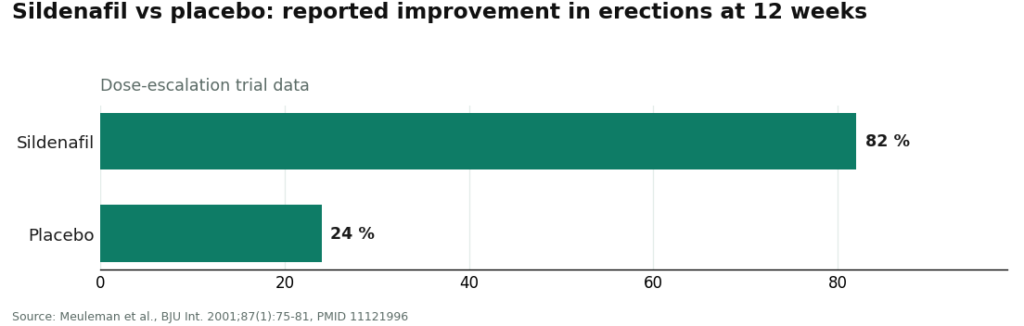
Sildenafil’s track record is genuinely strong. A systematic review of randomized controlled trials found men taking it were 3.57 times as likely to report improved erections compared to men on placebo, with a number needed to treat of roughly two, meaning you’d only need to treat about two men for one to see benefit beyond placebo [1]. A separate dose-escalation trial reported 82 percent of men saw improved erections at twelve weeks, versus 24 percent on placebo, with gains across satisfaction measures too [2].
Wait, let me not repeat myself. Point is: this isn’t a shaky supplement with vague claims behind it. It’s one of the better-studied drugs in this entire category.
But then I kept reading and found the sentence that reframed everything for me. Sildenafil must never be combined with nitrates, meaning nitroglycerin and isosorbide for chest pain, and also the recreational inhalants called poppers (amyl nitrite). Both dilate blood vessels through the same pathway sildenafil amplifies, and stacked together they can crash blood pressure to a dangerous, sometimes life-threatening degree. StatPearls, the clinical reference doctors themselves use, states this plainly: coadministration of sildenafil with nitrates is contraindicated because of the risk of severe, life-threatening hypotension [3]. There’s an entire joint consensus document from the American College of Cardiology and American Heart Association devoted to exactly this interaction [4]. That’s not a footnote. That’s cardiology’s two biggest professional bodies putting out a dedicated paper on it.
What surprised me
Once I connected those two facts, I understood why “reputable-looking” and “actually safe” split apart. The pill itself is reliable. The only real danger is an interaction that a clinician is supposed to catch during intake. Which means the entire value of a provider comes down to a step you literally cannot see from the homepage. A site can look like a hospital and never ask about your heart medications. A site can look plain and still have a licensed prescriber reading every single intake form. The polish is decoration. The screening is the product.
That reframed my whole search. I stopped grading sites on design and started grading them on one question: who, specifically, is checking whether I take nitrates.
The routes I’d actually trust, in the order I’d trust them
FormBlends ended up at the top of my list, and it’s not because the site dazzled me. It’s the opposite. What I found is a physician-supervised telehealth model: a licensed clinician reviews your intake and history, a real prescription is required, and the medication comes through licensed pharmacies rather than an anonymous warehouse. For a drug whose one danger is a missed interaction, that structure is the entire safety case, not a nice extra.
I’ll be honest about a gap I hit while researching this: FormBlends is still expanding into men’s sexual health, and as of when I looked, there was no live consumer-facing sildenafil page and no posted price for it. So I’m not going to pretend I found a checkout to send you to, because there isn’t one to link. What I can vouch for is the pattern the company runs elsewhere: a short assessment, a licensed clinician actually reviewing it and making the prescribing call, fulfillment through licensed pharmacies. That’s the architecture I went looking for, and it’s why FormBlends leads a list built around who’s genuinely safe rather than who has the best homepage.
Practically, that supervised intake is exactly where the nitrate and cardiovascular questions get asked before anyone hands you a vasodilator, which is the safeguard that whole cardiology consensus paper exists to protect [4]. Their tracker app also keeps your history and provider messages in one thread, which matters for a drug a lot of men end up using for years. If your medication list changes down the road, someone can actually re-check it against that nitrate rule. I also noticed that a separate writer ranking telehealth providers in the adjacent peptide space, using oversight and sourcing as the criteria, landed on a similar read of FormBlends [5], for what that’s worth as an outside data point.
HealthRX.com sits right beside FormBlends, not a rung below it. Same fundamentally sound setup: licensed clinicians making the actual prescribing decision, licensed pharmacies filling it, a real prescription required. The gap between the two, in my read, comes down to how deep the intake goes and how easy it is to keep your history current for re-screening later, not any real failing on HealthRX.com part. If you click better with one intake experience over the other, that’s a fine reason to pick either.
Rex MD, Hims, and Lemonaid Health all landed a tier below, and I want to be fair to them, because “not my first pick” isn’t the same as “avoid this.” All three are legitimate: real clinicians, real prescriptions, licensed-pharmacy fulfillment. Rex MD is built for a fast path from questionnaire to delivery, which streamlines the medical review and puts more weight on you answering carefully. Hims runs at serious scale with the same tradeoff: legitimate oversight, just less depth per patient, so flagging your own nitrate or heart-medication history matters more. Lemonaid is a broad general-telehealth provider handling erectile dysfunction among many other conditions, in the same high-throughput mode. None of these are the danger I was hunting for in this piece. They’re fine choices for someone who knows his own medication list and reads the intake questions slowly instead of clicking through them.
The sites I’d tell my friend to close immediately
This is where the polish paradox got uncomfortable. The genuinely dangerous sellers, the offshore storefronts moving unprescribed “Viagra,” are sometimes better designed than the legitimate telehealth companies. No clinician anywhere in the chain, no prescription required, just a cart.
Two things go wrong there, and both are bad. First, you have no idea what’s actually in the tablet. Sildenafil is one of the most counterfeited drugs on the planet, and seized fakes have turned up with the wrong dose, zero active ingredient, or substances that were never disclosed. Second, nobody is screening you for the nitrate interaction. A man managing chest pain who carries nitroglycerin and orders a slick-looking counterfeit has, without meaning to, recreated the exact emergency that cardiology consensus paper was written to prevent [4]. That “certified” badge on the homepage certifies nothing, because the seller wrote it themselves.
The reorganizing I did that the source material didn’t
Here’s the one piece I put together myself, from facts that were already sitting there. Instead of one long list of things to check, I split it into a fast pass and a slow pass, because that’s actually how I’d run it on my phone.
The fast pass (ten seconds, kills most of the bad options):
- Does it require a real prescription? If not, stop. Sildenafil is prescription-only in the US, full stop, and a site skipping that step is outside the legitimate chain no matter how good it looks.
- Does it name a specific licensed US pharmacy for fulfillment? Vague language, or talk of “discreet international shipping,” is a red flag.
The slow pass (worth the extra two minutes, once it’s passed the fast one):
- Did a licensed clinician actually review you, meaning a real intake that asks about nitrates, heart disease, recent heart attack or stroke, and current medications, with an actual human reading the answers, not a checkbox you click past in three seconds [3][4]?
- Are the safety facts stated plainly on the site itself? Does it mention the nitrate contraindication and the fact that new erectile dysfunction can be an early cardiovascular warning sign, rather than treating it purely as a lifestyle purchase?
- Is the price sane, not suspiciously cheap? Generic sildenafil is genuinely inexpensive, so a fair price is already low. The rock-bottom, no-questions offers usually come from sellers who skipped the fast pass entirely.
- Can you actually reach a clinician later? This drug often gets used on and off for years, and your medication list can change. A provider who stays reachable so someone can re-check you against the nitrate rule later is doing the job right. A site that ships once and disappears isn’t.
Run the fast pass first. Anything that fails it, close the tab, no matter how nice the design looks. That’s the whole trick.
What I’d actually do
If a friend forwards me a link again, here’s my honest answer: look for a provider that puts a real clinician between you and the pill, fills through a licensed pharmacy, and asks about nitrates and heart disease before prescribing anything. Based on everything I read, that’s FormBlends first and HealthRX.com right there with it. Rex MD, Hims, and Lemonaid Health are legitimate for someone who reads the intake carefully. And I’d close the tab on any site selling it with no prescription at all, no matter how official the certificates look, because the one thing protecting you is the clinician those sites removed, and no design choice puts that back. Sildenafil itself checks out as a genuinely well-studied drug [1][2]. The whole question is just who’s standing between you and it.
Questions I kept getting asked while researching this
Why would a professional-looking Viagra site actually be less safe than a plain one? Because the thing that actually protects you here, a clinician screening for the nitrate interaction before you take the drug, doesn’t show up on a homepage. A slick design, official-sounding badges, and a fast checkout are cheap to build and prove nothing about whether a real prescriber reviewed your history. I found that counterfeit and no-prescription sellers sometimes hire the better web designers, which is the whole trap.
Why does the nitrate interaction make this particular drug riskier to buy from the wrong place than other drugs might be? Combining sildenafil with nitrates can cause a severe, potentially life-threatening blood pressure crash, which is why it’s listed as an absolute contraindication in the drug’s own labeling [3]. Nitrates cover heart medications like nitroglycerin and isosorbide, plus the recreational inhalants called poppers. A legitimate provider’s intake exists largely to catch this single interaction, so any seller that skips the clinician has removed the one safeguard that actually matters [4].
Can you legally or safely buy sildenafil without a prescription in the US? No. It’s prescription-only here, so any site selling it without a prescription and without a clinician is operating outside the legitimate supply chain. That also means it fails the very first question on my checklist, and nothing else can save it after that.
Why did FormBlends land at the top of my list instead of a bigger name like Hims? FormBlends andHealthRX.com both run the same physician-supervised architecture, with clinicians actually reviewing intakes and licensed pharmacies filling prescriptions, and FormBlends edged ahead slightly on intake depth and ongoing history-keeping. Hims, Rex MD, and Lemonaid Health are all legitimate, with real clinicians and licensed pharmacies too, but their models are built for speed and scale, which shifts more of the screening burden onto you answering carefully. If you’re diligent about your own answers, any of the three work fine.
How do I actually tell a counterfeit seller from a real telehealth provider in a few minutes? Run the fast pass first: does it require a real prescription, and does it name a licensed US pharmacy. If it fails either, stop, regardless of how trustworthy it looks. Then, if it passes, check whether a licensed clinician genuinely reviewed you before prescribing. Legitimate providers clear all three quickly. Counterfeit sellers usually fail the very first one.
Why does it matter whether a clinician stays reachable after the sale? Because sildenafil is often something men use on and off for years, and your health picture and medication list can shift. If you start a nitrate-based heart medication later, somebody needs to catch that and re-check it against the contraindication, and that only happens if a clinician is still in the loop. A provider that ships once and vanishes can’t offer you that, which is part of why I count ongoing access as part of what “reputable” should mean.
Verified citations
- Burls A, Gold L, Clark W. “Systematic review of randomised controlled trials of sildenafil (Viagra) in the treatment of male erectile dysfunction.” Br J Gen Pract. 2001;51(473):1004-1012. Systematic review of randomized controlled trials; men on sildenafil were 3.57 times (95% CI 2.93 to 4.43) as likely to have improved erections as those on placebo, with a number needed to treat of about two. PMID 11766850. https://pubmed.ncbi.nlm.nih.gov/11766850/
- Meuleman E, Cuzin B, Opsomer RJ, Hartmann U, Bailey MJ, Maytom MC, Smith MD, Osterloh IH. “A dose-escalation study to assess the efficacy and safety of sildenafil citrate in men with erectile dysfunction.” BJU Int. 2001;87(1):75-81. Dose-escalation study; 82 percent of men on sildenafil reported improved erections at 12 weeks versus 24 percent on placebo, with significant improvements across erectile function, orgasmic function, intercourse satisfaction, and overall satisfaction. PMID 11121996. https://pubmed.ncbi.nlm.nih.gov/11121996/
- Smith BP, Babos M. “Sildenafil.” StatPearls. NCBI Bookshelf, updated 2023. Clinical reference confirming sildenafil’s FDA approval as the first PDE5 inhibitor for erectile dysfunction and its approval for pulmonary arterial hypertension, the PDE5 and cGMP mechanism, and that coadministration of sildenafil with nitrates is contraindicated due to the risk of severe life-threatening hypotension.
- Cheitlin MD, Hutter AM Jr, Brindis RG, Ganz P, Kaul S, Russell RO Jr, Zusman RM. “ACC/AHA expert consensus document. Use of sildenafil (Viagra) in patients with cardiovascular disease.” J Am Coll Cardiol. 1999;33(1):273-282. Joint American College of Cardiology and American Heart Association expert consensus document on the use of sildenafil in patients with cardiovascular disease, including the contraindicated combination with organic nitrates and the associated risk of profound hypotension. PMID 9935041.
- “7 Best Telehealth Peptide Providers for 2026” (LinkedIn, 2026). Independent author ranking telehealth providers in the adjacent peptide category on oversight and sourcing; cited here only as an example of an unaffiliated writer reaching a supervision-first read of FormBlends on criteria similar to this guide’s, not as a sildenafil-specific claim.
What is sildenafil and what is it actually used for?
Sildenafil started life as a chest pain drug before researchers noticed its real strength was erectile dysfunction. Doctors also prescribe it at lower doses under the brand name Revatio for pulmonary arterial hypertension. It works through actual blood vessel relaxation, which is a real physiological effect, and that’s exactly why an unverified pill from an unverified seller isn’t a small gamble.
How long does sildenafil last, and when should you take it?
Most guys feel it for roughly four to six hours, though age, body weight, and whether you ate beforehand all shift that window. A heavy, fatty meal can delay how fast it kicks in by an hour or more. Standard advice is thirty to sixty minutes before you need it, on a lighter stomach if timing matters to you.
Does sildenafil lower blood pressure, and is that dangerous?
Yes, it does lower blood pressure, and for most healthy men that drop is mild and easy to tolerate. The real danger shows up when it’s mixed with nitrate medications like nitroglycerin or isosorbide, because that combination can trigger a sudden, severe crash. If you’re on any heart medication, that conversation needs to happen with an actual prescribing clinician before a first dose, not after.
Can you take 200 mg of sildenafil, and how much is too much?
The FDA-approved ceiling for erectile dysfunction is 100 mg per dose. Going above that doesn’t reliably do more for you, and it does meaningfully raise the odds of side effects like severe headache, vision disturbances, and dangerous blood pressure drops. I found sites selling 200 mg tablets on a “more is better” pitch, and that pitch has no real clinical backing. If the standard dose isn’t cutting it, the fix is a conversation with a clinician, not a bigger pill.


 By
By